Top 10 Steel Fabrication Materials for Global Buyers
Steel fabrication begins with a practical question: which material can meet the design, production, and delivery requirements? Steel Fabrication Materials vary in strength, corrosion resistance, weight, weldability, and cost. A choice that works well for an indoor frame may fail in a coastal setting where salt and moisture are constant concerns.
This guide introduces ten material groups global buyers may encounter, including carbon steel, stainless steel, galvanized steel, alloy steel, and weathering steel. It considers how each option performs in common fabrication tasks, from cutting and forming to welding and finishing. Details matter. A grade name alone does not confirm that a product suits the job; thickness, documented properties, surface condition, and supplier traceability also deserve attention. Ask for relevant technical documents, and compare offers using the same specifications.
Purchasing decisions also involve lead times, available sizes, transport, and the consistency of supplied batches. These factors can affect project schedules as much as the material’s quoted price. Not every buyer needs the most advanced grade. Sometimes, a readily available option is the sensible choice. Still, a shortlist cannot replace engineering review or inspection against project requirements. This overview offers a starting point, not a universal ranking; actual performance depends on the design, fabrication process, and operating environment.
How Steel Fabrication Materials Are Classified
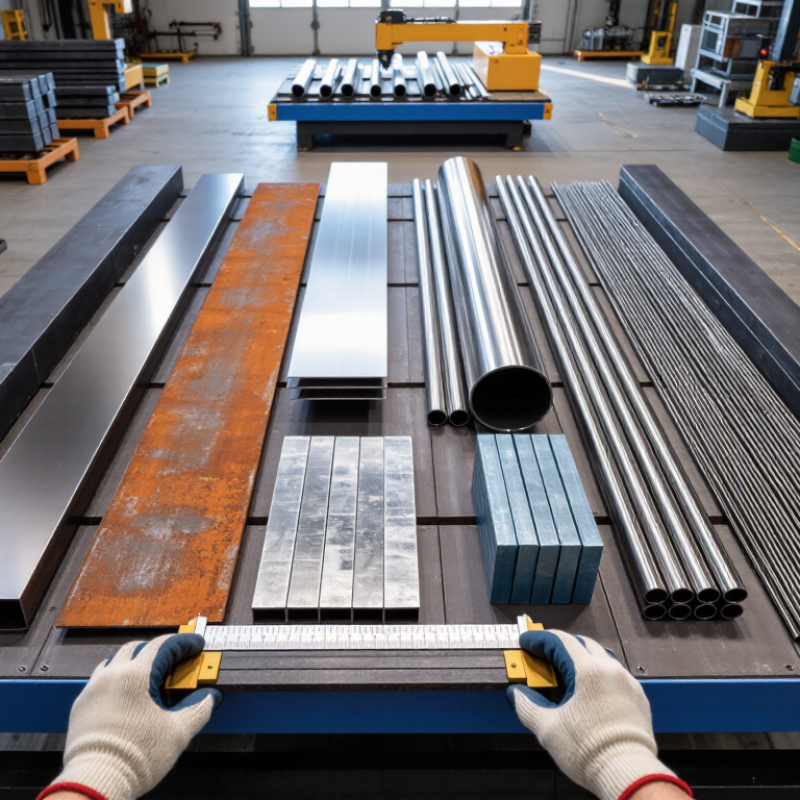
Steel fabrication materials are classified by chemistry, product form, and surface condition. Chemistry groups include carbon, alloy, and stainless steels, with different strength, corrosion, and welding characteristics. Product form identifies what reaches the shop: plate, sheet, bar, beam, tube, or wire. Surface condition may be uncoated, galvanized, or otherwise coated.
The World Steel Association’s World Steel in Figures 2024 reports global crude steel production of 1,892.2 million tonnes in 2023. At this scale, clear material descriptions help buyers and fabricators avoid costly mix-ups.
Classification alone is not enough. A plate and a sheet may share a steel grade but differ in thickness and intended processing. Buyers should compare grade, dimensions, tolerances, finish, and required mechanical properties against the fabrication drawing.
Check the material certificate and traceable heat number before cutting; once stock is divided, identification becomes harder. These categories can overlap, and supplier descriptions are not always consistent. That deserves a second look.
Tip: Match the material class to the operation. For laser cutting, bending, or welding, confirm thickness and documented properties before ordering. Keep labels with offcuts. Small detail, big difference.
The Ten Most Common Materials Used in Steel Fabrication
Top 10 Steel Fabrication Materials for Global Buyers
The Ten Most Common Materials Used in Steel Fabrication
Steel fabrication commonly uses carbon steel, structural steel, high-strength low-alloy steel, galvanized steel, 304 and 316 stainless steel, weathering steel, alloy steel, tool steel, and abrasion-resistant plate. Each serves a different purpose. Carbon steel is easy to cut and weld; galvanized steel adds a zinc coating for corrosion resistance. Stainless grades suit wet or hygienic environments, while weathering steel forms a protective surface patina. Alloy and tool steels are selected for strength, heat resistance, or hardness. Abrasion-resistant plate is useful where buckets, chutes, or liners face repeated wear. Structural and HSLA grades can reduce weight while meeting load needs. Grade names can be confusing, and similar-looking plates may behave differently during welding.
The World Steel Association reported 1,892.2 million tonnes of crude steel production worldwide in 2023 in World Steel in Figures 2024. The International Stainless Steel Forum reported 58.4 million tonnes of stainless steel production that year in Stainless Steel in Figures 2024. These figures show the scale of steel supply, but they do not tell buyers which grade fits a specific project. One common mistake is treating “steel” as a single material. It is not.
Tip: Match the grade to the environment, loads, fabrication method, and finish. Check the material certificate and confirm thickness before cutting. Details matter. A cheap grade can become costly if corrosion or wear is overlooked.
Key Properties That Affect Fabrication and Performance
Steel selection depends on more than price per tonne. Yield strength affects load capacity, while ductility influences bending and forming without cracking. Weldability, corrosion resistance, and thickness also shape fabrication time and service life.
The World Steel Association’s World Steel in Figures 2024 reports 1,892.2 million tonnes of crude steel production in 2023, reflecting the scale of the material choices facing global buyers. Scale does not make grades interchangeable.
ASTM A36 specifies a minimum yield strength of 250 MPa for many common thicknesses. That figure helps buyers compare structural options, but it does not predict performance by itself.
For austenitic stainless steel, a typical thermal expansion coefficient is about 17.2 μm/m·°C over a moderate temperature range. Repeated heating can therefore move joints and distort thin panels.
Small details matter. Surface condition and cutting method can also affect corrosion behavior, so confirm the grade and finish against the actual application.
Tips: Request mill test certificates and verify grade, thickness, and heat number before cutting. For welded assemblies, test a sample joint when practical; shop conditions rarely match ideal data sheets. I would also question any quote that compares strength alone. It is a useful starting point, not a full fabrication plan.
How Buyers Compare Grades, Forms, and Standards
Global buyers should compare steel by grade, product form, and governing standard—not by a familiar trade description alone. World Steel Association’s World Steel in Figures 2024 reports 1,892.2 million tonnes of crude steel production in 2023, but scale does not make products interchangeable. A36 and A572 structural plate, for example, differ in specified mechanical properties; sheet, coil, sections, and pipe also require different dimensional checks. Small differences matter. For stainless products, ISSF reported 58.4 million tonnes of melt-shop production in 2023. Grades such as 304 and 316 may look alike on a sample, yet their specified composition and intended service differ. Choose against the actual environment and design needs, not a supplier’s shorthand.
Standards make comparisons useful only when buyers specify the right document and edition. ASTM A240 covers stainless plate, sheet, and strip; ASTM A312 covers stainless pipe; ASTM A615 covers reinforcing bars. For structural steel, buyers may encounter ASTM or EN specifications, whose grades and test requirements should not be assumed equivalent. Check the certificate. Confirm grade, thickness, dimensions, heat number, test results, and any required impact properties before shipment. Ask whether tolerances apply to the finished form, not just the base material. I still see procurement lists that name a grade but omit thickness tolerance or delivery condition. That gap can create costly rework, even when the paperwork appears complete.
Top 10 Steel Fabrication Materials for Global Buyers
How Buyers Compare Grades, Forms, and Standards
The chart compares specified minimum yield strength for selected grades and product forms. Values are rounded to the nearest MPa; applicable limits can vary by thickness and standard edition. Buyers should confirm the exact specification, dimensions, and material test certificate for each order.
Global Sourcing Factors for Steel Fabrication Materials
Global buyers may source carbon-steel plate, sheet, coil, bar, angle, channel, beam, pipe, tube, and stainless steel. But product names alone do not define suitability. A beam for a warehouse and a thin sheet for enclosures need different tolerances, grades, and surface conditions.
Start with drawings and service conditions. Confirm grade, thickness, width, length, straightness, and permitted dimensional variation before comparing quotations. Ask for mill test certificates and agree how heat numbers will be traced through cutting and packing. Details matter. For coated or corrosion-resistant material, specify coating weight, finish, and expected exposure; salt air can change the choice. Independent inspection may be useful for critical orders, though it adds time and cost.
Compare total landed cost, not just the unit price. Freight, duties, cutting losses, packaging, insurance, and delivery reliability can shift the real budget. Check loading ports, shipment size, lead times, and whether stock can be replenished consistently. Keep sample records and inspect the first shipment against agreed measurements. Paperwork can look complete while bundles still arrive mixed. That risk is easy to underestimate. Suppliers may explain a deviation, but the buyer should decide in advance what evidence is acceptable and what happens when material fails inspection. Sourcing plans are never perfect; a small trial order can reveal gaps before production depends on them.
 North American Safety Valve Industries, Inc.