
How to Choose the Best AC Condensers for Global Buyers?

Choosing the right Ac Condensers requires more than comparing prices on a supplier website. Global buyers must assess performance, materials, refrigerant compatibility, and long-term service conditions. A condenser installed near a salty coastline faces different risks than one operating in a dry inland warehouse. Small details matter.

Start with the operating data. Check cooling capacity, airflow, fan power, allowable pressure, connection size, and working temperature. Confirm that the condenser matches the intended refrigerant and system design. Copper tubes, aluminum fins, and protective coatings should suit the local environment. Ask for test reports, product drawings, warranty terms, and traceable quality records. Reliable manufacturers can explain these details clearly. They should not hide behind vague efficiency claims.

Supply consistency matters too. Buyers should review production experience, export history, packaging methods, and spare-parts availability. A sample inspection may reveal bent fins, weak brazing, or poor labeling before a large order is shipped. Confirm dimensions carefully; a unit that cannot pass through a service doorway creates an expensive installation problem. Freight planning also deserves attention, especially when several condenser sizes share one container. No checklist is flawless. A low price can mislead. Buyers may overlook noise, maintenance access, or seasonal performance during negotiations. Comparing verified data from several suppliers creates a more dependable decision. The best Ac Condensers are not simply the cheapest products; they are suitable, documented, serviceable, and proven for the buyer’s actual market.
How to Choose the Best AC Condensers for Global Buyers?

Define Cooling Load with ASHRAE 1% Design Temperatures and Peak kW

How to Choose the Best AC Condensers for Global Buyers?

A condenser should match the real cooling load, not a convenient catalog number. Use the ASHRAE 1% cooling design temperature for the target location. This temperature is exceeded during roughly 1% of annual hours. It represents a demanding, realistic outdoor condition. Calculate peak cooling load in kW, including walls, sunlight, people, equipment, ventilation, and infiltration. Then check condenser capacity at that outdoor temperature, refrigerant, airflow, and altitude. A rating at mild conditions can be misleading.

Tips: Separate cooling capacity kW from electrical input kW. Record the design dry-bulb temperature, indoor target, and operating schedule. Ask for performance data at your actual condition. Check coil face area and fan airflow, especially in dusty or coastal sites. Leave practical service clearance.

Field experience shows that peak demand often appears when occupancy, lighting, and outdoor heat rise together. I have seen equipment selected from average weather data struggle during a short afternoon peak. Oversizing is not automatically safer; it may increase cost, cycling, and control problems.

A spreadsheet can look precise and still be wrong.

Review the assumptions with a qualified HVAC engineer and compare them with local energy codes. For global purchasing, request test conditions, sound data, shipping dimensions, and maintenance access before approval. Local conditions matter more than a simple capacity label.

Match Condenser Capacity Using AHRI 210/240 Ratings and SEER2 Metrics

For global buyers, condenser selection starts with a matched system, not a large number.
AHRI 210/240 defines standardized rating methods for unitary air conditioners and heat pumps. It reports cooling capacity in Btu/h and efficiency through seasonal metrics. The test point is controlled, commonly including 95°F outdoor conditions for cooling ratings. Real rooftops are rarely so polite.

Use the AHRI-certified combination, then compare its rated capacity with the building load. A 36,000 Btu/h condenser should not be paired casually with any 36,000 Btu/h indoor coil. Coil design, metering device, airflow, refrigerant charge, and line length can change performance. SEER2 reflects seasonal efficiency under updated DOE test procedures, including external static pressure. It is useful, but it is not a guarantee for every climate. DOE compliance tables and AHRI certification records should be checked together. A catalog match can still fail.

The IEA report The Future of Cooling projects that cooling energy demand could triple by 2050 without stronger efficiency action. That forecast makes seasonal performance commercially important, especially where cooling seasons are long. Compare SEER2, rated capacity, and sensible capacity at the expected outdoor temperature. Ask for AHRI-certified data at 82°F, 95°F, and higher ambient conditions when available. Buyers often oversize after seeing a hot design day. That feels safe, but it can increase cycling and humidity problems. Verify local voltage, climate, and certification rules. Small omissions become expensive.

Compare Refrigerants: R-32 (GWP 675) vs R-410A (GWP 2,088)

For global buyers, refrigerant choice can change the condenser’s safety design, service cost, and future availability. R-32 has a global warming potential of 675, while R-410A reaches 2,088 under commonly used 100-year assessments. The difference is significant. It may also affect a project’s environmental reporting and market access.

R-32 usually requires equipment designed for mildly flammable refrigerants. Installers need suitable ventilation, leak detection procedures, and approved electrical components. R-410A is non-flammable, but it operates at high pressure and still demands correct tools, recovery equipment, and trained technicians. Never treat one refrigerant as a direct substitute for the other. Their condensers, compressors, oil requirements, and charge calculations may differ.

Check the condenser nameplate carefully. Confirm the refrigerant, operating pressure, ambient temperature range, coil material, and available spare parts. A unit intended for a coastal site may need stronger corrosion protection than one used inland. Supply chains also matter; R-410A may remain familiar in some regions, while R-32 equipment can support lower-GWP targets. Local regulations can change the practical answer.

A lower GWP is not automatically the best purchase. Poor installation can erase efficiency gains through leaks and unstable charging. That part is easy to underestimate. Ask for verified performance data, factory test records, and technician certification. I would also compare seasonal efficiency, not only rated capacity. A cheaper condenser may become expensive when service access, refrigerant training, or replacement parts are limited. This is where many buying decisions need another look.

Evaluate Coil Materials, Corrosion Classes, and EN 14511 Test Conditions

For global buyers, condenser selection starts with the installation climate, not the catalogue price.

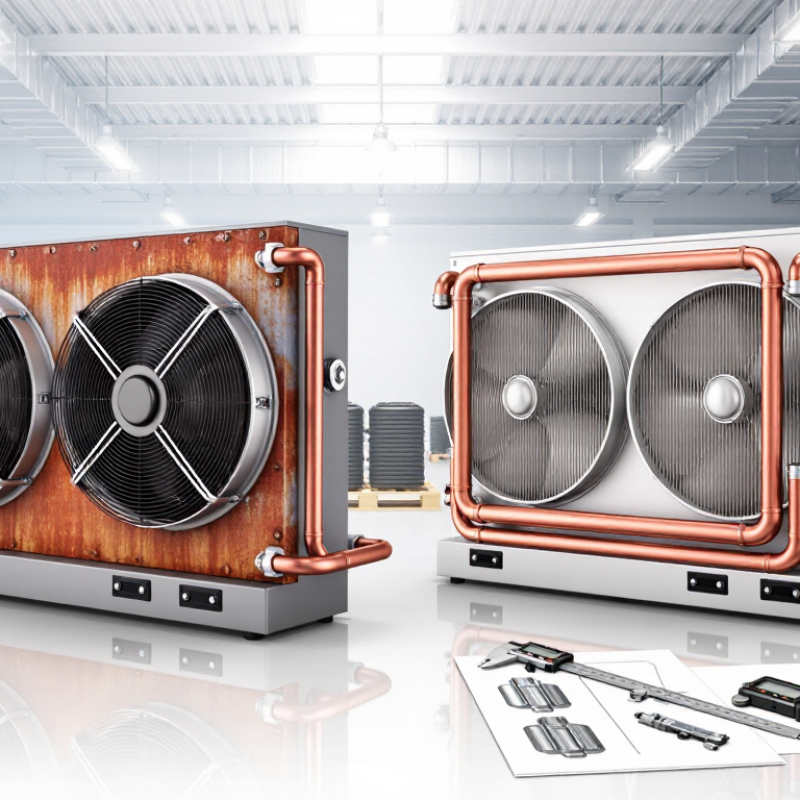
Material choice matters. Copper tubes with aluminum fins transfer heat reliably and remain familiar to service teams. Aluminum microchannel coils can reduce weight and refrigerant volume, but blocked passages are less forgiving during cleaning. In coastal air, salt deposits attack exposed metals quickly. Specify fin protection, tube joints, drain paths, and coating adhesion. Do not accept “anti-corrosion” as a complete specification.

Corrosion class should describe the site. C3 may suit moderate urban exposure, while C4 or C5 screening is more appropriate near heavy industry or saltwater. Marine locations may require C5-M consideration. These classes guide risk evaluation; they do not replace coil-specific testing. Ask for coating thickness, salt-spray evidence, and inspection criteria. Field checks should include fin swelling, white corrosion products, and galvanic contact points. A cheaper coil can become an expensive maintenance problem.

EN 14511 adds a necessary performance reference for the complete air-conditioning unit.

Compare cooling capacity, power input, and efficiency at identical standard rating conditions. Check entering and leaving air temperatures, airflow, outdoor temperature, and refrigerant configuration. A capacity figure without these conditions is weak evidence. Request accredited laboratory reports or traceable test data. I have seen selections based on one headline number, then fail under hotter outdoor air. That mistake is easy to repeat. Also review part-load performance, because real buildings rarely operate at one rating point.

Verify Safety, Efficiency, and Compliance Across 50/60 Hz Global Markets

How to Choose the Best AC Condensers for Global Buyers?

Selecting an AC condenser requires more than comparing cooling capacity. The IEA’s Future of Cooling report estimates that space-cooling electricity demand could more than triple by 2050. Efficiency matters. Check COP, EER, and seasonal ratings under comparable test conditions. A larger condenser may cool faster, but it can cycle poorly and waste energy. Field inspections often reveal another issue: a unit rated for 60 Hz may not perform correctly on a 50 Hz supply. Verify frequency, voltage, phase, motor speed, starting current, and control compatibility before purchase.

Safety and compliance need equal attention. IEC 60335-2-40 addresses safety requirements for air-conditioning equipment, including refrigerant-related risks. IEC 61000-3-2 also helps assess harmonic current limits for electrical equipment. Ask suppliers for current test reports, factory inspection records, wiring diagrams, and refrigerant declarations. Do not rely only on a certificate number. Documents can be outdated, incomplete, or tested under different conditions. Compliance with one market does not guarantee acceptance in another.

Tips: Request samples for both 50 Hz and 60 Hz evaluation. Compare noise, discharge pressure, vibration, and power draw at local ambient temperatures. Confirm the condenser’s IP rating and corrosion protection for coastal sites. A low watt figure can mislead. Review the complete system, not one component. Then have an independent laboratory verify critical claims against the destination market’s requirements.